Dear @Community friends,
I hope this finds you well, and that since we last corresponded your models have remained sensibly sized, your coordinates correctly aligned and your browser tabs free from the pale, unresponsive expression of a Victorian child encountering a ghost.
Earlier this week, Speckle released something enormous. :stonks:
I have spent the intervening days elsewhere on the internet performing the traditional launch rituals: pointing at graphs, saying “ten times” with significant eyebrows, and demoing a large federated model as though I had personally installed every pipe. But the virtual promotional tour is over, the eyebrows have been stood down, and I can finally return to my comfortable Speckle Community chair and write to you properly.
You remember the chair. Slightly worn, surprisingly supportive and positioned among people who will respond to “ten times faster” by asking “using which dataset?” before this increasingly compromised correspondent has even removed my coat.
We rebuilt Speckle’s database architecture.
I realise this is not the sort of news for which people traditionally wait beside the letterbox. “Dearest friend, the database architecture has been rebuilt!” lacks some of the emotional range of wartime correspondence. But it means that extremely large models—the masterplans, the corridors, the multi-discipline federations, the models which stopped being files several gigabytes ago and began administering their own regional transport policy—now load quickly and remain responsive in the browser.
Previously, opening one of these models involved a sequence of respected professional techniques:
- dividing it into pieces,
- hiding several disciplines,
- exporting a static copy,
- finding a larger computer,
- finding the person who possessed the larger computer,
- discovering that they were on leave,
…and eventually concluding that nobody truly needed to inspect the mechanical system.
The mechanical system knew what it had done.
We are now seeing up to ten times faster processing and at least ten times better visualisation performance. Naturally, numbers in a launch announcement should be treated with the suspicion reserved for holiday postcards, restaurant menus and containing photographs. “Weather magnificent. Lasagne magnificent. Database magnificent.” One wants evidence that any of these things have survived contact with reality. just like Grindr profiles.
Fortunately, José ( @jaribeirovargas ) wrote back.
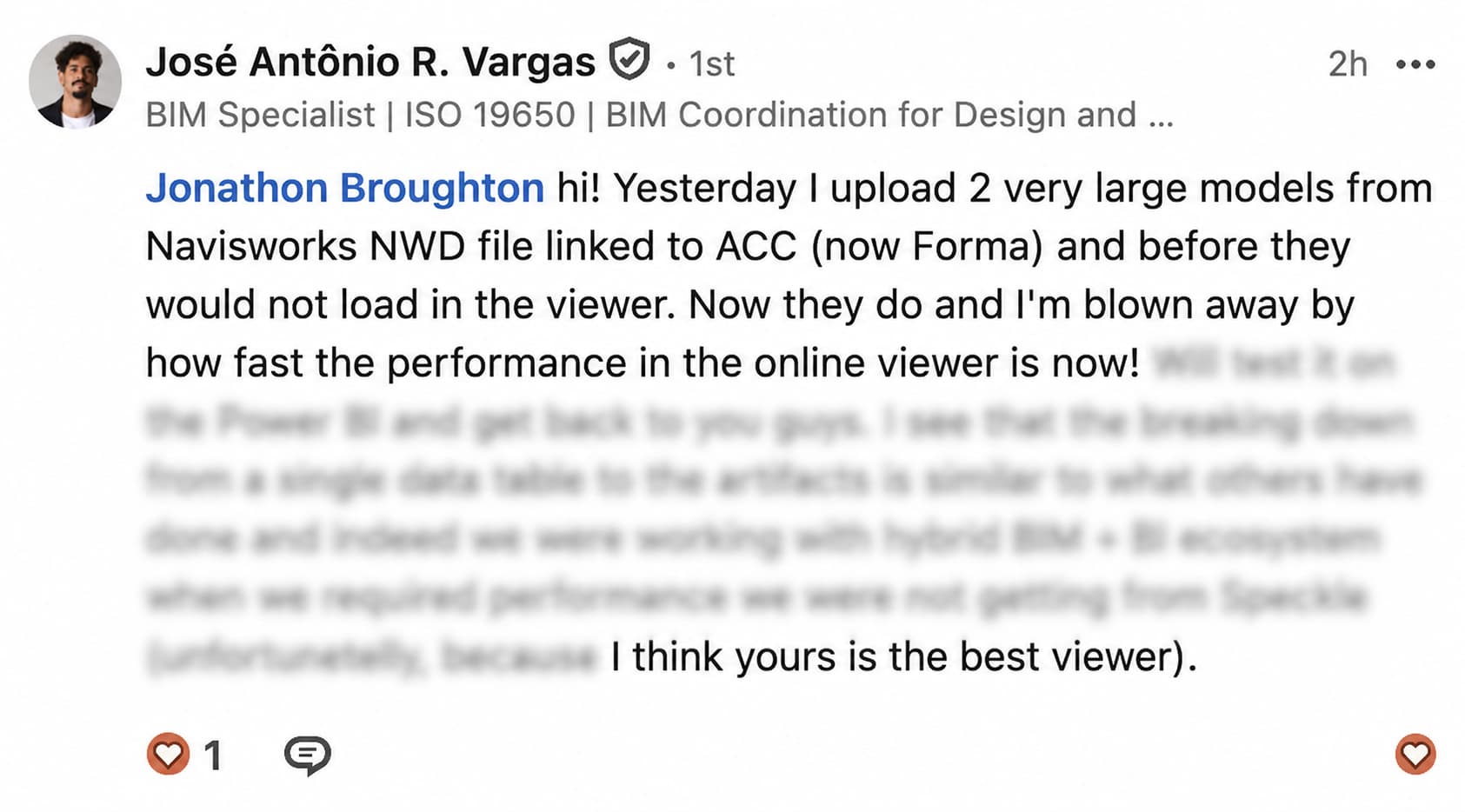
He uploaded two very large Navisworks models linked to ACC—now Forma, because Autodesk can rename a product more quickly than this correspondent can complete a dependent clause—which had previously refused to load.
This time, they opened.
“It loads now” is not conventional launch language. It contains no paradigms, no transformation and no photograph of six attractive colleagues drawing circles on a transparent wall. But anyone who has watched a browser tab become an unresponsive white rectangle understands that “it loads now” is among the most beautiful phrases in our profession.
Perhaps not as beautiful as “the consultant has issued the correct coordinates”, but this is a letter about events which have actually occurred. (fun fact we have a fixe for when they don’t!)
And the model does not merely appear, like an extremely complicated ghost summoned by sufficient RAM. Speckle now accurately encodes its topological relationships—spatial relationships, systems, networks and the connections between them—making the data available for graph analysis.
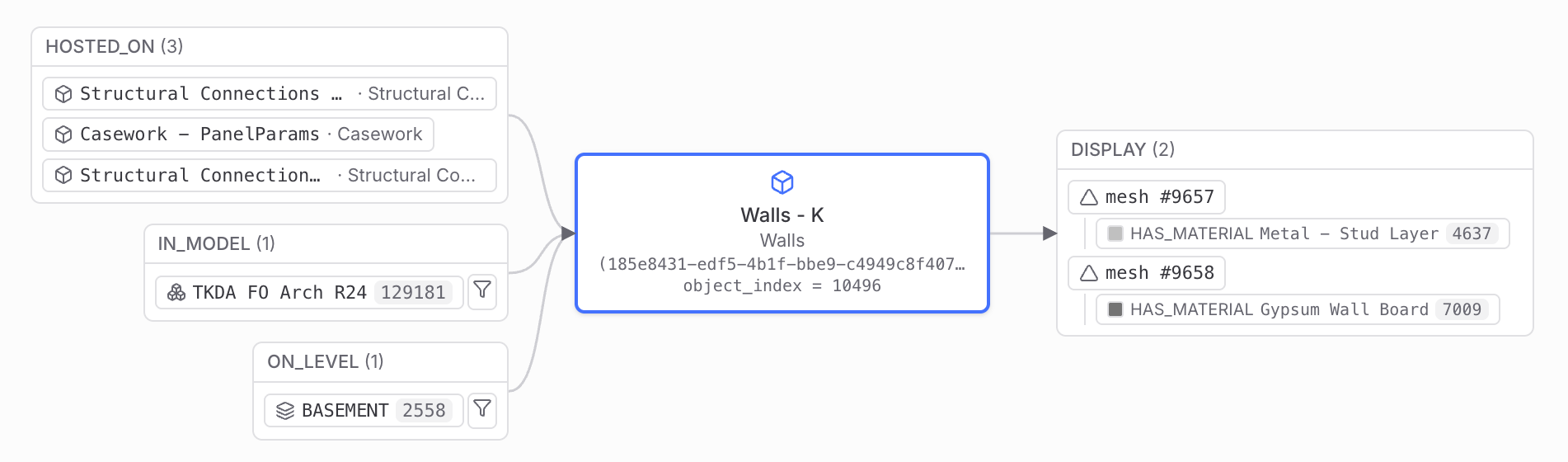
So it is no longer merely an enormous collection of objects.
It is an enormous, connected collection of objects…
…That loads now.
This distinction has cost us several years, which is why I have underlined it twice in spirit.
The rebuilt architecture also gives Speckle Intelligence something useful to be intelligent about.
Yes, dear Community, AI.
Please remain seated. The chair was designed for difficult correspondence.
The interesting part is not that Speckle now contains a box into which you may type a question. Civilisation has produced thousands of boxes into which one may type a question, many of which will answer with extraordinary confidence about a building they have never seen.
Speckle Intelligence reads directly from the live, connected model.
Not a PDF exported on Tuesday. Not a spreadsheet reconciled against a model that changed on Wednesday, reviewed on Thursday and renamed FINAL_v8_ACTUAL_FINAL_USE_THIS_ONE.xlsx on Friday by someone whose deteriorating faith in language can be reconstructed from the version history.
The actual model.
You can ask it questions, use it for reporting and validation, and inspect how it reached an answer so you can check the result against the source. It shows its work because “the machine seemed certain” is not yet an accepted information-management standard, although I assume a committee has been formed.
Not a weekend goes bay without what passes for social media in AEC professing again that uploading a STEP/IFC into Chad Jippity can give an element count with attitude. Speckle Intelligence may have swagger but it makes nothing up - that data it reports - thats yours, precisely and accurately.
So that is my news from earlier in the week: very large models moving much faster, their spatial, system and network relationships retained for analysis, and practical AI working directly from live project data rather than from a static export discovered beside FINAL_v7_DO_NOT_USE .
Now I would love to hear your news.
Please send your difficult models. Ask Intelligence the questions that normally require three exports, four spreadsheets and the one colleague who knows why the quantities differ but has made the understandable decision never to explain it. Tell us what works, what fails, what surprises you and what piece of repetitive data drudgery you would surrender to a machine without even arranging a leaving collection.
What will you ask of your model? What have you already asked and been astonished at what you’ve found?
Until then, I remain here in the comfortable Speckle Community chair, awaiting your reply.
Although Martin has just written to ask whether the chair itself has encoded topological relationships.
It does, Martin.
It is connected to the floor.
And it loads now.
Yours in large models, live data and increasingly strained correspondence,
Jonathon 